

How to Spot Fake Victorian Brass Door Knockers: A Beginner's Guide
A brass door knocker is one of those small domestic objects that quietly does a lot of work. It announces visitors, ages a front door beautifully, and carries the dents and polish of a century of use. It is also one of the most reproduced items in the antiques trade. Cast iron foundries, Indian workshops and British gift suppliers have been turning out "Victorian" knockers for decades, and some of them are very convincing in a photograph.
The good news is that fakes tend to give themselves away in the hand rather than on the screen. Casting technology, metal composition and a hundred years of weather all leave marks that are extremely difficult to imitate convincingly. Here is what to look for.
Start With the Casting Marks
Almost every genuine Victorian knocker was made by sand casting, and sand casting leaves evidence. Run your fingertips over the reverse of the plate, the parts that sit against the door. A genuine casting has a slightly grainy, uneven surface, sometimes with a faint sandy texture or small pitted hollows where gas escaped the mould. Modern reproductions, especially those made in rubber moulds or die-cast in large batches, tend to be suspiciously smooth on the back, or covered in a uniform stipple designed to mimic age.
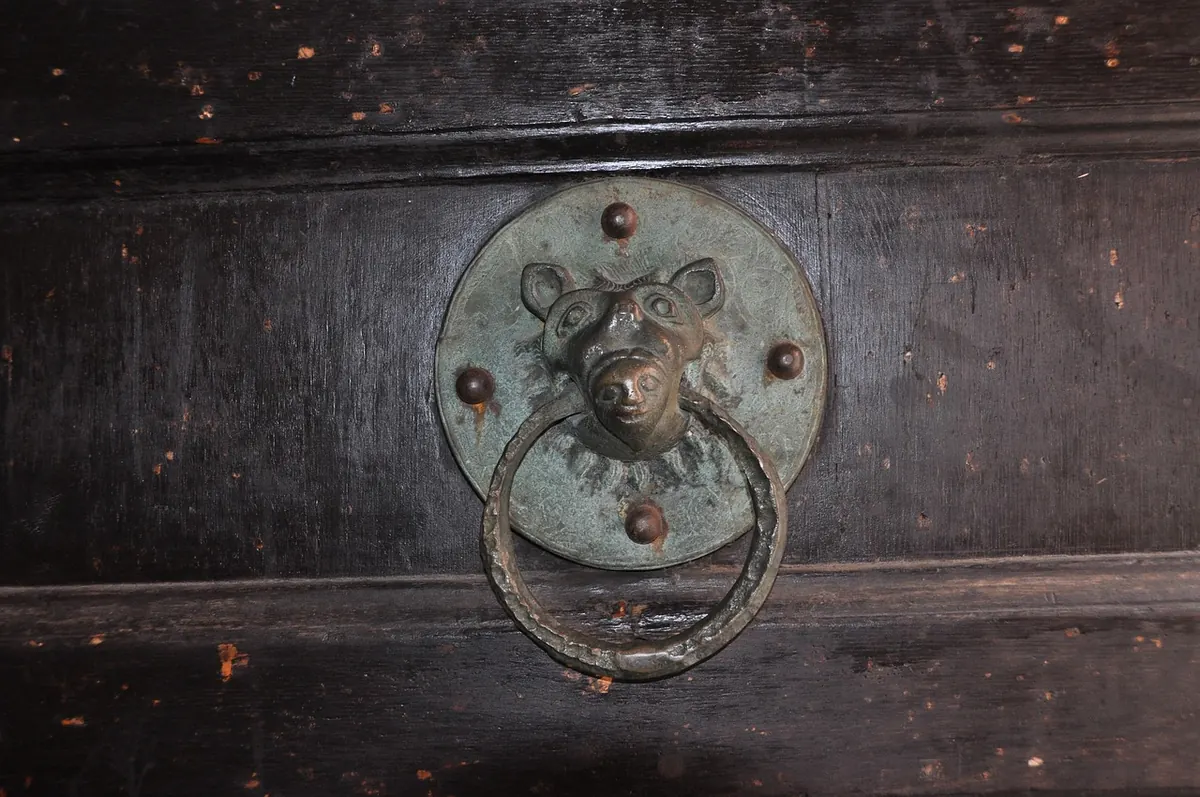
Look closely at the sharpest details: the lion's mane, the acanthus leaves, the lettering on a letter plate. Genuine casting was done from a pattern that had often been used many times, so fine detail is frequently a little soft or slightly blurred at the deepest points. Counter-intuitively, a knocker with crisp, machined perfection across every curl of foliage is often the newer piece.
Seams, sprues and file marks
Where the two halves of a mould met, you will often find a faint seam line. Where the metal was poured, there was a sprue, and a foundry worker would have filed or chiselled it away. Look for a small flattened patch, a subtle tool mark or an area where the surface texture differs slightly. These traces of hand-finishing are a good sign. Perfectly uniform edges on a knocker that claims to be 150 years old deserve suspicion.
Read the Patina, Not the Shine
Brass does not simply get darker with age. It reacts to its environment. Outdoors, it develops a brown-to-green surface layer, sometimes with a warm golden glow where hands have repeatedly touched it. Indoors, it usually darkens to a soft brown-black in the recesses while staying brighter on raised areas.
That distribution matters. On a genuine knocker, the hinge, the striking plate and the top of the ring or knocker arm are the places most worn and most polished by use. The deep backgrounds of the design stay dark and grubby. Reproductions are often artificially aged with a chemical dip or a dark wax that sits evenly across the whole surface, including in places a real knocker would never be rubbed. If the recesses and the high points are exactly the same shade, be wary.
Genuine wear is never symmetrical. Look for one side of the knocker that has clearly seen more hands than the other.
Check the Metal Itself
Many "brass" knockers are brass-plated cast iron or zinc alloy, or a yellow-brass imitation with a high zinc content. A magnet will usually stick firmly to cast iron and to most plated zinc-alloy reproductions, whereas solid brass and bronze are not magnetic. That single test rules out a great many modern pieces in seconds. It is not infallible, since some genuine knockers were made in cast iron and japanned black, but if a seller insists on solid brass while a magnet clings to it, you have your answer.
Colour is a weaker clue but still useful. Genuine aged brass has a slightly muted, greenish-brown or honey tone. New yellow brass, particularly the polished sort sold in hardware shops, is a brighter, more lemon-yellow colour. Look at the inside of a screw hole or an unexposed edge if you can: fresh, bright yellow metal underneath an aged surface usually means a plated or chemically coloured modern casting.
Wear, Fixings and the Small Details
The fixings can be as revealing as the knocker. Genuine Victorian knockers were usually fixed with hand-made slotted screws, often with slightly off-centre slots and irregular heads. Modern reproductions come with crisp, machine-made Pozidriv or Phillips screws, which did not exist in the Victorian period. If the screw holes show fresh, sharp countersinking with no sign of old corrosion, that is another mark against it.
Check for repairs and honest damage too. Old knockers have often had a hinge pin replaced, a tail mended, or the striking plate worn into a shallow depression by decades of impact. A knocker that shows no wear at all where the moving part meets the fixed part has probably not been used for very long, whatever its date of manufacture.
A quick checklist for a viewing or a market stall:
- Take a small magnet. Iron or plated alloy will attract it; solid brass will not.
- Feel the back of the plate for a gritty sand-cast texture rather than a smooth, moulded finish.
- Compare the colour of the deep recesses with the raised, handled areas. They should not match.
- Inspect the screw holes and fixings for handmade slotted screws rather than modern cross-heads.
- Look for a file mark, seam or sprue scar from the original foundry.
- Weigh it in your hand. Genuine solid brass knockers feel notably heavy for their size.
- Ask what the seller knows about its history, and listen for vague claims about "a house clearance" with no detail.
A Practical Closing Note
No single test settles the question. A reproduction can be heavy, and a genuine knocker can be light if it is a hollow casting. Use the clues together: casting texture, wear pattern, metal type, fixings and the honest clumsiness of handmade finishing. Three or four consistent signs pointing the same way is far more persuasive than one dramatic detail.
If you are buying for pleasure rather than investment, this matters less than you might think. A well-made reproduction on a Victorian door looks perfectly at home, and plenty of collectors knowingly buy later copies because they like the design. What you want to avoid is paying a genuine-antique price for something cast last year. Buy from dealers who are happy to let you handle the piece, ask direct questions, and be willing to walk away. The knockers worth owning will still be there next week.
Photo: Northern_Punkie / Pixabay